Wednesday, August 24, 2011

Exploring USB Devices

The 9-pin or 25-pin D-Sub type serial port connector is going the way of the dinosaurs on most computers these days. Yet, the people who make add-on gadgets such as TNCs, antenna controllers, etc. still crank out products that require a serial port connection. Fortunately a lot of companies make USB-to-Serial converters. Some even make good ones.

I don't claim this is a scientific evaluation by any means. It is just my observation. While any USB-to-Serial converter may work in some cases it is my experience that those with an FTDI or Prolific chipset inside them will always work.

Anytime I buy a new USB-to-Serial adapter I try to buy one that tells me what chipset it uses. Then, if I have a choice, I usually get the FTDI variety mainly because they were some of the first ones I found to work well and they provide good support and information.

But what if you have a device and have no idea what it uses? Knowing the chipset manufacturer may help you troubleshoot a problem. Microsoft has a neat little utility circa 1968 called USB Viewer. It will show you all of the USB controllers and hubs in your system plus in most cases it will identify whose chipset is inside them and even what model chipset in some cases. In the picture below I've plugged in an adapter with a Prolific chipset.


This utility is available free. Download USB View from the FTDI Website

Happy hunting!

73,

Tim N9PUZ


Wednesday, August 17, 2011

32-Bit Power Comes to the Arduino World


If you've ever wished you could have a little extra horsepower for your Arduino project then this may be just the thing. Digilent Inc. has a new 32-bit chipKIT product. One version features the Microchip PIC32MX320F128 and the other a PIC32MX795F512. Both are MIPS processors. Details are found at the link above including where to download a compatible development environment.

The PIC32MX795F512 on the chipKIT Max32 board supports Ethernet, CAN bus, and full USB 2.0 connections.

73,

Tim N9PUZ

Friday, August 05, 2011

Comparing Base Station Antennas

Sometimes you read about something in a book but you don’t really give it a lot of thought. Recently I had a chance to observe the performance of two different antenna types and I can confirm that the design differences can really affect the performance.

On my tower at home I have two dual-band VHF/UHF antennas. One is an Arrow Ground Plane @ 55ft, the other is an Arrow J-Pole @ 45 ft. Both are fed by the same type coax.

One evening I was trying to use the W9BIL D-STAR repeater in Cadwell, IL which is 49.1 miles from my house according to QRZ.com. The ground plane is normally used by my Winlink RMS Station and the J-Pole is normally on my shack’s dual band radio.

I was pleased when I was able to key up the repeater operating with the J-Pole although the signal strength meter barely moved. I switched to the ground plane antenna thinking the extra 10 foot or so of height might help a little but to my surprise I could not hear W9BIL at all. I never thought much about the antennas being all that much different and assumed that height would trump anything else.

Some research was in order.

Discounting the difference in height which should have helped if everything else was equal there are two other factors that come into play:
  • Antenna Gain
  • Angle of Radiation

Let’s look at three antenna types: a simple ground plane, a J-Pole which is a 1/2 wave antenna and a 5/8 wave antenna which is another popular style for VHF/UHF.

Antenna Type
Reference Gain
Angle of Radiation
1/4 Wave Ground Plane
0.0dB
25°
1/2 Wave J-Pole
+ 0.85 dB
20°
5/8 Wave
+ 2.35 dB
16°


The lower radiation angle puts more of the power you’re radiating at the horizon. The higher gain means the antenna pattern is also focusing the power in the most desirable direction.

For the curious, going longer than 5/8 Wave tends to hurt your cause. Beyond that length the radiation angle begins to increase.

You may be wondering why I included the 5/8 Wave antenna when I didn’t have one to compare. Well, it turns out several companies like Comet make nice 5/8 Wave antennas for Amateur Radio use at fairly reasonable prices. You never know when an upgrade may be in order!
  
73,

Tim N9PUZ

Sunday, July 10, 2011

D-Star Progress

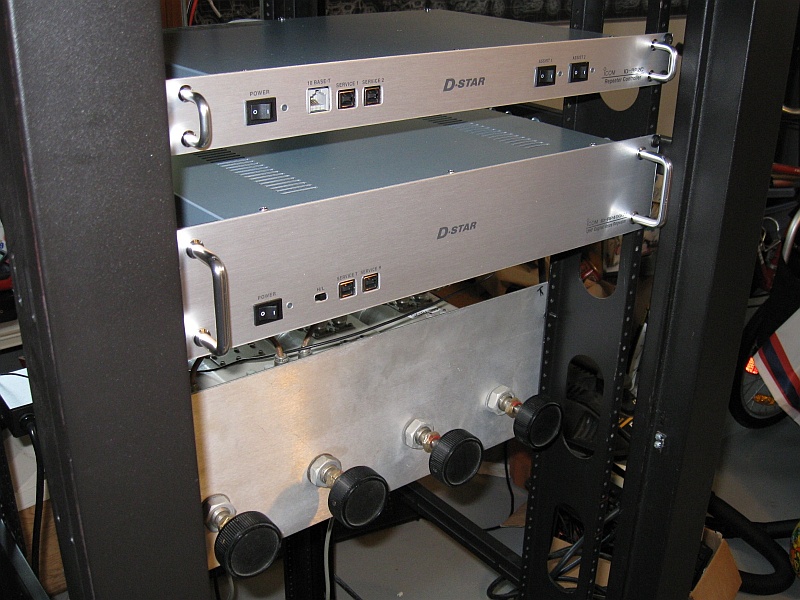
W9DUA D-Star UHF Gear


The Sangamon Valley Radio Club's new D-Star repeater continues to move forward. The repeater itself won't move to its final location until the end of July/start of August but the gateway is now operating full time and accepting self-registration. If you are a new D-Star radio owner or DV-Dongle user in our area and are not currently registered in the D-Star network please join us!


73,

Tim N9PUZ

Monday, July 04, 2011

Web Site Updates

Happy Independence Day to all of you in the United States!

I made a couple of minor updates to the main web site today. First, I got an email from Chris NØTTW telling me that the Programmable ROM I mentioned in my article on updating the KPC-3 TNC is no longer available. Second, I freshened up the listing of programs that are suitable for doing Winlink 2000 email here in Sangamon County, IL.

73,

Tim N9PUZ

Friday, July 01, 2011

Watson, Come here! W9DUA D-Star Repeater


Today was a major milestone in the Sangamon Valley Radio Club's D-Star repeater project. We got the controller, UHF repeater, and duplexer mounted in the rack and did some initial configuration of the basic system with a temporary antenna.

Around 4:30pm central time N9UWI and I had a successful digital voice QSO through the repeater.

Next order of business will be to get the gateway computer installed and reguster the system on the US Trust Server to allow Internet linking, etc.

73,

Tim N9PUZ

Sunday, June 26, 2011

2011 ARRL Field Day

I spent most of Field Day with the Sangamon Valley Radio Club in Riverton, Illinois. The best way to describe it overall was wet. It rained lightly on and off while we were setting up. Then just before 1pm local time the lightning and thunder began. People operated on and off as conditions permitted. We did have a good time which is important.

Shelter was plentiful. The school at Riverton where we operate makes the cafeteria, restrooms, etc. available. A few people even operated from inside with cables run out the doors to the temporary antennas. The weather may not have cooperated but it was still a day of fellowship and fun.


Don N9ZGE (Left) and Rudy KC9LSM (Right) look on while Don W9EBK tends the grill.

Vicki KC9JPQ

Bob NA9GW

 Roger K9LJB


 Teri K9TLM (Left) and Claudia N9HHE (Right)

Tom W9EBY


There were a lot more club members present, I just didn't get many pictures taken.

73,

Tim N9PUZ

Wednesday, May 25, 2011

Kudos to Ameren Illinois

This morning we lost power during a thunderstorm. The repair crew said they thought a lightning strike took out the breaker on the pole with the feed for our house. We lost power around 6:30am. They stopped at the house around 8:00am to say they were out of the part on their truck and had to go replenish their supplies. By 9:30am or so we had power again.


Pretty good service I think.

73,

Tim N9PUZ

Friday, May 13, 2011

The Poor Ham's Radial Plate

A lot of discussion around building an HF vertical includes talk of a "radial plate" to attach your radial wires to the ground side of your feedline. There are several commercial offerings that look similar to this one from LDG (S9 Antennas):


These are all well and good but they strike me as being a little pricey for what they accomplish. With a little effort and a trip to the hardware store for a piece of aluminum flat stock you can get enough material to build several for about $10 or less. Fabricate yourself something along these lines:


When I originally sketched this I indicated 2" wide flat aluminum. In fact 1" wide stock or even 3/4" would probably work as well and will be less expensive.

------

Well, ideas abound on simple solutions to this. My buddy Scott NE1RD sent along a link to show the technique he used on the 40 Meter vertical at his new house. Not only is it economical but you don't have to drill any holes yourself!

Plumber's Strap

73,

Tim N9PUZ

Wednesday, May 11, 2011

Easy Ethernet Connections

There was a time when I could attach an RJ-45 plug to a piece of CAT5 cable very quickly and without a great deal of thought. That has changed over the years. Now that my eyes, as well as the rest of me, have made 55 trips around the sun I find that things are'nt quite so easy as when they were "less experienced." Getting the wires ready, cutting them to just the right length, fitting them into the connector, crimping, and then trying to see if all eight have a good connection can be a chore. Fear not aging geek, there's hope.

The folks at Bowmar Interconnect have a new RJ45EZ connector. The design is very simple and pure genius. Have look here:

The end of the RJ45EZ has holes in it. You strip the jacket back so you have plenty of wire to work with. Then you thread each wire through the proper hole. Once you verify they're correct you crimp the connector in place and finish up by trimming off the excess wire.

The Bomar connectors are carried by most of the regular suppliers such as Digi-Key, Allied, Mouser, etc. I did a search around the time I wrote this post and found the least expensive price at CMH Electronics in Canton, OH. Single pieces were around $1. The part number you want is Bomar 300668EZ.

In addition to their intended use the RJ-45 is also common on the microphone cords of many amateur radio products. Having a few of these on hand for repair work could save you from having to buy an expensive cable from the manufacturer.

Now, if I could just quit forgetting where I put down my glasses...

73,

Tim N9PUZ

Friday, May 06, 2011

SparkFun Electronics

A lot of us like to tinker and build and several people have mentioned getting cool stuff from SparkFun Electronics. I'm always interested in knowing how neat companies like this got started and how they operate. Recently, the 37 Signals blog Bootstrapped, Profitable and Proud did a piece on SparkFun. It sounds like an interesting place to work. Heck, you can even bring your dog with you!

Nathan Seidle (left, in a photo from CNNMoney.com)


Keep on tinkering!

73,

Tim N9PUZ

Wednesday, April 06, 2011

Past Projects

This post was inspired by a hamfest purchase. Earlier this year I stumbled across an old issue of Circuit Cellar Ink and just had to buy it.

When I first studied electronics in school microprocessors were really expensive. Little 8-bit chips were hundreds of dollars so the community college I attended certainly didn't have any in the lab for us to play with. In the mid 1980's I'd wait for each new issue of BYTE Magazine to arrive and would immediately go to Steve Ciarcia's Circuit Cellar column. Those articles were the basis of my self-education in learning how to design and program what came to be known as embedded systems.

One day I saw brief mention that Steve was looking for people to be a part of his research staff. What the heck, it would be fun to at least apply so I sent off my letter... this was pre-Internet after all, at least as we know it today. A few weeks later to my disbelief Steve himself called on the telephone to discuss things and I became part of the staff which is another story entirely. I'll save that for a different day.

Eventually BYTE was purchased by McGraw-Hill and their battalions of attorneys wasn't too keen on the idea of Steve telling readers how to modify electrical equipment or even build their own from scratch. A new magazine "Circuit Cellar Ink" was born and the researchers followed our leader.

In those early days articles were needed to fill the pages while word spread. My friend Dennis WD9EEK and I co-wrote an article called Stepping Out, A Robot Arm that Demonstrates Microprocessor Control of Stepper Motors. It appeared in the July/August 1988 issue of the magazine (Volume 1, No. 4.)

 
It was a lot of fun being part of the research staff and a lot of fun working with Dennis on the project. Up until that point I'd never used a stepper motor before but I was a lot younger at the time and my attitude towards most new challenges was usually "How hard could it be?"

I hope you've had some fun projects both past and present.

73,

Tim N9PUZ

Friday, March 04, 2011

Quality Audio Connectors

A pet peave of mine is cheap, crummy connectors. They are often difficult to install plus they frequently cause all sorts of tough to diagnose intermittent problems. Recently I came across some really high quality 1/8-inch (3.5mm) mono and stereo connectors from Neautrik/REAN. They are available from Mouser in the US and undoubtedly many other suppliers as well. Cheap connectors are often well less than a dollar. These are $1.50 or more but you build a cable with one once and it just keeps working. A wise investment in my mind.

The mono plug is P/N: NYS226BG. The stereo version is P/N: NYS231BG. These are the real deal. Black metal handles, gold plated contacts.

73,

Tim N9PUZ

Friday, February 25, 2011

Always A Thrill...

Yesterday's postal mail brought one of my favorite things. New magazine? No. New catalog full of new toys? No. The letter carrier brought an envelope from the Northern Illinois DX Association . NIDXA is a DX club but they also run the 9th District Incoming QSL bureau. The envelope contained a dozen QSL cards from stations in Columbia, Poland, Greece, Spain, Croatia, Italy, Germany, France, and French Guianna.

I am not a big time DXer nor do I have anything approaching a superstation. Most of the time I run 100 Watts or less to an "all band" 80 Meter dipole fed with balanced line. Occasionally I'll use my amplifier on SSB but that's a rare event.

When you first get your HF privileges any contact is a thrill. If you spend a little time to learn more about propagation you'll find that a lot of the time your timing is more important than anything else. You increase the likelihood of DX contacts tremendously by knowing when to listen. Are you on a band with possible propagation at the time of day when it should occur? Is it a time of the day or week when the DX will be around, i.e.--not sleeping, not at work, etc.

Often, good times to listen for DX are the few days before a big contest. The frenzied atmosphere of the contest hasn't begun but lots of stations are verifying that antennas and equipment work, etc. You'll also find that the DX is more likely to engage in an actual conversation outside of the contest. On the other hand, don't be put off with just a short signal exchange and a 'thank you'. In many cases the operator on the other end may not actually speak English and has made an effort to learn just enough to make a contact.

73,

Tim N9PUZ

Sunday, October 17, 2010

Online Mapping Tools

The other day I was looking at NVIS antennas and wondered what sort of coverage I might get from my location. Basically I wanted to see a circle drawn around my town with a radius of around 300 miles. The solution was at the Free Map Tools website. Specifically the Radius Around A Map Point page.

In addition to solving my immediate problem there are all sorts of other potentially useful things there. Give it a look.

73,

Tim N9PUZ

Thursday, September 30, 2010

Simulated Emergency Test - 2010

This Saturday, October 2nd, is the 2010 Simulated Emergency Test or SET. If you are an ARES member I hope that you're planning to participate in some form or another. This helps to keep us ready for the day when a large scale disaster strikes and we have no instant messaging, no tweets, no Facebook, no cell phones.

Here in Springfield, Illinois where I live we have a new opportunity for the first time in many years. This will be the first activation of the new RACES station at the Illinois Emergency Management Agency. The station isn't fully operational yet as equipment has just started arriving but we do have some HF capability along with local VHF/UHF comms. We're bringing in all three operating teams to do some training and a little building and configuration along the way.

73,

Tim N9PUZ

Monday, September 27, 2010

Illinois Sideband Net

Traffic handling is a dying art that we really should save. It's hard to think of sending a message through the National Traffic System when we have cell phones, email, and even shudder, the plain old telephone system. But when the chips are down, and one day they will inevitably be down, at least some commercial infrastructure will fail. Amateur Radio and the NTS will still work--if we remember how to use it.

The Illinois Sideband Net meets every day at 6:00pm local time. The frequency is 3.905 MHz SSB. There isn't typically much if any traffic to pass. The beauty of checking in every day or at least once a week is that you know your antennas are still up, the radio and power supply works, and you remember how to use it all. If you are a Ham living in Illinois please stop by some evening for a visit.

You can read up on working within a traffic net on the ARRL web site.

73,


Tim, N9PUZ

Saturday, September 18, 2010

Peoria Superfest

Two major events today. First, it was my wife Teri K9TLM and my 28th wedding anniversary. Life just keeps getting better. Second, this is the weekend of the Peoria Superfest which we have attended for many of those 28 years.

This is a long running central Illinois hamfest. This year the weather was against them. A fairly severe rain storm just before lunch time kind of killed off the flea market business. An awful lot of people packed up and headed home early. Too bad, the weather was beautiful later in the afternoon.

It was good to see old friends and put faces with newer ones. Most notable was a face to face meeting  with James K8JHR from Wyoming, MI. We've talked on the radio several times and had many email discussions but meeting up at big events like Dayton has eluded us.


On the way home Teri and had dinner with friends Bob K9KGO and Dorothy KB9WAN at a neat little place in Mason City, IL named Jack and Jo's. Excellent food. I highly recommend the Cajun Pasta but I can't recall ever having a bad meal there.

Hope you had a good Saturday as well.

73,

Tim N9PUZ

Friday, September 10, 2010

Jim Dunn K9CNP (SK)

September 9th was a sad day. My long time friend Jim Dunn K9CNP passed away. Writing about Jim deserves more of a book than a blog post but I want to hit a few of the highlights.

I first met Jim in 1977. He was an instructor in my Novice licensing class taught by the Sangamon Valley Radio Club. He became one of my Elmers and we've remained close friends ever since.

Jim was a Broadcast Engineer. He maintained many of the area AM & FM radio stations. A few years after we first met he took a position as Chief Engineer for the radio station at the University where I worked. There were many memorable lunch time discussions and a work related projects that I enjoyed very much. You never worked with Jim on anything without coming away having learned something.

Jim was very active in Amateur Radio to the end. He was a Volunteer Examiner for years, The ARES Illinois Section Traffic Manager, and the ARES Emergency Coordinator for Sangamon County. Jim also co-founded our local Sangamon/Menard County ARES group.

In his spare time Jim liked to travel, operate outdoors, and camp. He also built beautiful Native American style flutes.

Jim K9CNP doing what he loved.
20 Meter CW 2010 ARRL Field Day

I can't yet imagine how much we will all miss Jim. He will never be forgotten.

The wind is in the buffalo. (Jim will understand this)

73,

Tim N9PUZ

Saturday, August 21, 2010

North American QSO Party - SSB

Today was the NAQP - SSB Contest. Originally I wasn't sure if I could participate at all but it turns out I worked the contest for a couple of hours. The bands weren't great. I only operated on 40 and 20 Meters because my antenna decided it wasn't going to load on 15 Meters and by evening 75 Meters was horribly noisy here. I made 39 contacts with only 9 multipliers total.

All wasn't bad though. I had a great time and given condtions I was especially pleased with 39 countacts as I was running 5W QRP with the Flex 1500 SDR. Even with my 5W the other stations only asked for repeats a half dozen times or so. Sometimes I think running QRP is only a problem when the other station knows that you are QRP ;-)

73,

Tim N9PUZ